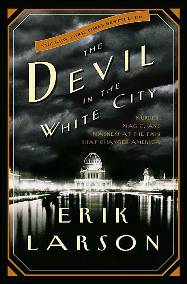
The Devil in the White City by Erik Larson - 2009 Nov
I'm not sure how I should make these posts flow, so here starts an experiment...or maybe my own novel...sorry I'm so long winded. I think in the future, I'll try separating these sections.
Finding the Book: Started off with buying the book, I suppose. We decided that we'd like to do fiction, and had a list of 4 or 5 going. None of us had a solid opinion, so I honestly just picked one.
The Devil in the White City by Erik Larson. I thought the tagline to be cheesy...something about murder, magic and mayhem at the world's greatest fair...but attributed that to overzealous editors. I went to a corporate bookstore (ugh) just because it was close and I got lazy. I scanned the fiction shelves, but no book. Since the store was closing, I asked a clerk to make the process quicker. She recognized the title and shepherded me over to the History section...?! Turns out,
The Devil in the White City is a non-fiction item. Curious as to why we didn't pick up on this, I purchased it (and noted the small paper signs denoting that it was an employee favorite). The checker also small talked me; she hadn't read it, but heard a lot about it. She asked a few questions about book club, but fearing a corporate club offer with a fee, I deflected.
For some reason, I always flip through a book quickly when I get it. I suppose it's the child in me checking for super cool illustrations. To my adolescent delight, a few b&w photos were layered in. I noted an extensive source guide, bibliography, and index. A true nonfiction? Also (not sure where to categorize this random observation), everywhere I carted the book in public, someone would notice the cover and tell me their opinion about it. I ran into more positive former readers than negative, which motivated me to keep reading.
Reading:The first 100 pages was like MUD for me to get though. Seeing no in-text citations, I noted that this book deliberately read like a fiction. I oscillated back and forth for awhile, finally deciding that the big-chain bookstore had categorized it correctly in History. The book began in the late-1800s (a period of great interest to me) and essentially bounced back and forth between two central characters. In short, an architect attempting to construct the world's greatest fair in Chicago, and a serial killer capitalizing on the opportunity of incoming murderable material. The author established his penchant for careful research early on...and took it too far early on as well, sometimes over-accentuating a small detail. For example, he would state a fact, insert a quote from a personal letter from any old Midwesterner, followed by a newspaper headline, followed by more musing upon said fact, and closed by a quote from a diary entry from another random Midwesterner. I felt bombarded sometimes by character names and/or source materials (I wished most were simply cited in the final indices). BUT this is why I love book club; had I been reading this for personal pleasure, the 100 page rule would have kicked in and I would have tossed it aside for a Shakespeare or something. Book club forces me to keep trudging even when I feel like quitting, if nothing else to tell them WHY I might have hated a piece of lit. But in the long run, I ended up enjoying this book for a lot of reasons. Despite the lack of narrative style that I craved (in my own personal opinion, of course), I always delight in intellectual provocation. When I was a child, I used to read Paul Harvey's
The Rest of the Story. CONSTANTLY. They are very short stories with the key fact in the last words (read a few on Amazon, you'll see why as a child I LOVED them). Anyway, this book was like a long-winded Paul Harvey story. There are links to Disney, Frank Lloyd Wright, Shredded Wheat, PBR, the invention of the zipper, the USA's answer to the Eiffel Tower (I won't spoil this one)...on and on. I LOVE that stuff! One thing that I was disappointed with, however, was the lack of new vocabulary. I read with a pencil and a dictionary. ALWAYS. I write definitions in the margins, but I'll tell you how many words I looked up...5.
- refulgent: shining radiantly (page 12)
- miasma: noxious atmosphere, poisonous vapor (page 28)
- inculcate: teach by repetition; instill (page 39)
- obstreperous: noisily & stubbornly defiant (page 58)
- somnambulistic: sleepwalking (page 105)
Out of 400 pages, I looked up 5 words and they were all in the first quarter. Not that I particularly enjoy a deluge of unfamiliarity, but if I look up a word per page, I'm really excited. Or, if I recognize a word that I looked up in, say,
One Hundred Years of Solitude, and now know what it means, I'm even more excited. None of that joy in this book. But I did have strong reactions to the images presented, particularly architecturally. I was propelled to the internet to conduct a visual search, which is always a good sign when I read (click the WHITE CITY image below).

Also, I found myself particularly entranced by the serial killer chapters (morbid, I know). The book was zippered up, alternating chapters between architect and murderer. I couldn't get through the architect chapters quickly enough to get back to the criminal. His name was H. H. Holmes (well, one of his names...you'll see!). Immediately I thought of Humbert Humbert, and I was not disappointed by this coincidental parallel.
In general, the note I wrote the most in the margins was "delusions of grandeur?"
Meeting: We met at the Rocket, a great local coffee shop and bakery. Attendees were Megan, Crystal, Minda, Jessica (and a foreign friend visiting for the time being) and me. (and I? Grammatically, not sure...moving on...). Perfect number of girls for a good discussion, upon reflection. Somehow I wound up facilitating, so I printed sets of questions that I found online. I'll link to them (reposting might be too long; let me know if you want me to repost in comments).
One set was by the publisher,
one set was random?,
and the other was a general question list that applies to any book. I was NOT strict by any means with questions, just brought one up when there was a lull in the conversation. Everyone finished the book, which is a good sign. The general consensus was that perhaps the author wanted to write a book about Holmes (aka serial killer) but did not have enough material to churn a book out on him alone. We all found him compelling the read. Four of us agreed about the first 100 pages being the obstacle. The questions that I brought up regarding the application of this piece of literature to real life didn't seem to light fires under anyone (Ex: Much was made about classical vs modern architecture, and no one had a solid opinion regarding it.). I wondered aloud what the author was telling us, what his final opinion regarding his own worldview, but only heard broad generalizations. Personally, I saw a striking parallel between the control and organization of this book, and the manic control issues H. H. Holmes displayed. There's an opportunity to distort the truth with the nonfiction/source material aspect of this book, and the same is true regarding the memoir/confession of the murderer. Both authors seem to display the same tendencies regarding the driver's seat (That thought doesn't make sense, but maybe I'll expand and refine it in the future).
Final:I dishonestly ranked the book highest, purely out of nicety. I had to be the example, and didn't want anyone to think I hated it, particularly in the first meeting of the group that I helped start. Didn't want to end on a sour note, I guess. Anyway, rankings were (I think) 5, 6, 6, 7 and 8. Not poor, but not stellar. I would recommend this book to the avid nonfiction reader, or to someone that feels confined by academia (maybe a bored college student). But not to a book club looking for deep, truthful discussions...unless the book club has ONLY read fiction for a solid year or more. It would be a good way to rock the boat in that case.
 what, chick lit? No, not quite...but close. Women-centered literature, empowerment, romance, etc. Would Fight Club deign to be a part of our "usual"? Apparently so! I have to make myself read these slowly, otherwise I'm done in a day or two. I'm already a quarter of the way through...I may have to put it down. But I love it, I forgot how witty it is. A friend I had heard that Chuck Palahniuk has to work really hard to get something good, but I don't care anymore! I adore this book. I thought that after watching the movie I might have Brad Pitt and Edward Norton (a personal favorite of mine) floating through my psyche, but they have miraculously faded away. Which has never happened to me before! I am excited, and thought that I'd share...although, I feel like I'm drinking more.









 Posts
Posts

